
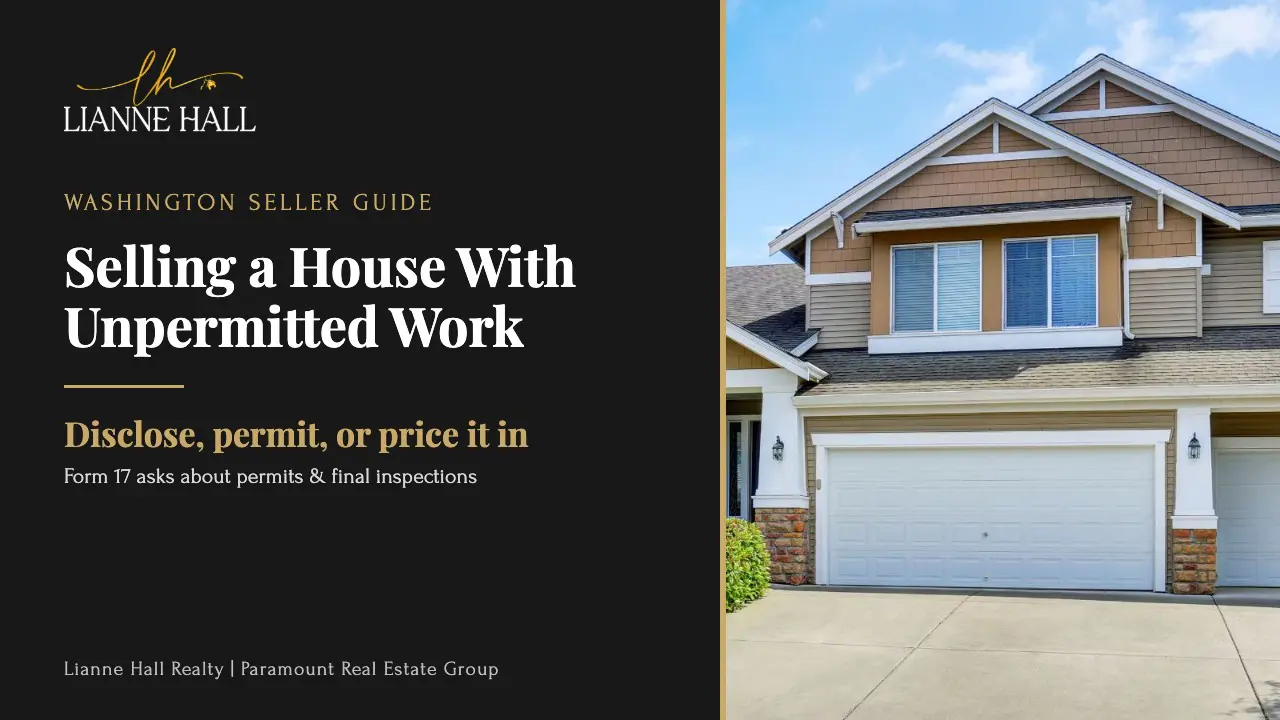
Almost every older house in Western Washington has something done without a permit. A finished basement. A garage turned into a bonus room. A deck that grew. A bathroom someone added in 2009 over a long weekend.
Sometimes you did it. Sometimes the owner before you did. Either way, the question lands the same way when you’re about to list: does this kill my sale, and what do I have to tell buyers?
It doesn’t kill your sale. But it does change your disclosure, how the appraiser treats the space, and who can buy the house. Here’s how I walk sellers through it.
Can you sell a house with unpermitted work in Washington?
Short answer: Yes. You disclose what you know on the Form 17 seller disclosure, which asks whether there have been any conversions, additions or remodeling and whether all building permits and final inspections were obtained. Then you pick a path: get an after-the-fact permit, fix or remove the work, or sell as-is with the work disclosed and priced in. In unincorporated Pierce County, a permit for work already done carries an investigation fee equal to the permit fee ($250 minimum, $5,000 maximum), which the county waives for an owner who bought the house without knowing about the work.
By Lianne Hall, REALTOR® | Paramount Real Estate Group | Updated November 24, 2026
What Form 17 actually asks you
Washington’s seller disclosure statement, NWMLS Form 17, comes straight from state law (RCW 64.06.020). In the structural section it asks three things in a row: Have there been any conversions, additions, or remodeling? If yes, were all building permits obtained? If yes, were all final inspections obtained?
Notice what it doesn’t ask. It doesn’t ask who did the work, and it doesn’t ask whether the work is good. It asks what you know. If you know a permit was never pulled, the answer is no, and the form tells you to explain on an attached sheet.
If you honestly don’t know, “don’t know” is a real answer. What you never do is guess yes to make the form look clean. A buyer’s inspector or appraiser will often pull the permit history, and a disclosure that doesn’t match the county record is how a normal negotiation turns into a dispute.
One more piece of timing: once the buyer receives Form 17, they generally have three business days to rescind unless they waived that right. A clear, upfront disclosure keeps that window quiet.
Why it matters beyond the paperwork: appraisal and financing
The bigger money issue usually isn’t the disclosure. It’s the appraisal.
Fannie Mae’s appraisal rules say that when an appraiser finds an addition without the required permit, they must comment on the quality and appearance of the work and its impact, if any, on market value. That’s not an automatic no. Well-built, permanent-looking work can still carry value.
In practice, though, appraisers often can’t count unpermitted square footage the same way as permitted living area. If your listing says 2,400 square feet and 400 of it is an unpermitted basement finish, the appraiser may treat the home like a 2,000-square-foot house with a nice bonus space. On a financed sale, that gap comes back to you as a renegotiation.
That’s why I want to know about the work before we price the home, not after the buyer’s appraisal comes back.
Option 1: Get an after-the-fact permit
Most jurisdictions here will let you permit work that’s already done. You apply as if it were new work, and the inspector decides what they need to see. Expect to open some drywall or ceilings so they can check framing, wiring and plumbing, and expect plans for anything structural.
In unincorporated Pierce County, the code adds a special investigation before a permit can be issued for work started without one. The investigation fee equals the permit fee, with a $250 minimum and a $5,000 maximum, and it’s charged whether or not the permit is ultimately issued. If you can show credibly that the work was done before you owned the home and without your knowledge, the county waives that investigation fee. The regular permit fees still apply.
Gig Harbor, Tacoma and the other cities run their own building departments with their own fee schedules, so call the right one before you assume the county rules apply to you.
This path makes sense when the work is valuable living area (a bedroom, a bathroom, a finished basement), when it was done reasonably well, and when you have a few months before you want to list. A permitted, finaled space is space you can market and an appraiser can count.
Option 2: Fix it or take it out
Sometimes permitting isn’t realistic. The work may not meet current code, or the zoning may not allow it at all. Sometimes it’s simply sloppy, and an inspector is going to find more than you want them to.
In those cases, the cleaner move is often to bring it up to standard with a licensed contractor and a permit, or to reverse it: turn the converted garage back into a garage, remove the questionable wiring, take out the second kitchen.
It costs money, sometimes a lot. But anything touching electrical, structure, or septic is where I push hardest, because those are the items that scare buyers and their lenders the most. If you’re on septic, Form 17 has its own question about whether the system was permitted and approved, which I covered in my guide to selling a home on septic in Pierce or Kitsap County.
Option 3: Sell as-is, disclosed and priced in
You can legally sell with unpermitted work in place, as long as you disclose what you know. Plenty of homes do.
The trade-off is your buyer pool and your price. Some buyers will walk the minute they see the disclosure. Some lenders will be stricter. Cash buyers and investors will stay, and they’ll price the risk of permitting or redoing the work into their offer.
If you go this route, do it on purpose. Price the home on the square footage an appraiser will actually count, describe the unpermitted space accurately in the listing, and have your explanation and any receipts or contractor info ready to attach to Form 17. Buyers forgive a known issue far more easily than a surprise.
Selling as-is isn’t the same as refusing to negotiate, either. If a buyer’s inspector flags the work, the same fix, credit or price-cut options from my post on handling a buyer’s repair request still apply.
How I decide which path fits your house
When a seller tells me about unpermitted work, I run through five questions before I recommend anything:
What is it? A shed or a patio cover is a footnote. A bedroom, bathroom or ADU is a valuation issue.
Is it safety-related? Electrical, structural, gas and septic work move to the top of the list.
Does it change the square footage? If yes, it changes the price, and we need to know how an appraiser will see it.
Who’s your likely buyer? If your buyer is financing, the appraisal decides how much of that space you actually get paid for.
What’s your timeline? A permit can take weeks to months. If you need to list soon, pricing it in may be the only real option.
Most of the time, the answer is a mix: permit the work that adds real value, fix anything safety-related, and disclose and price the rest. I’m not an attorney, so if the disclosure question gets complicated, I’ll point you to a real estate attorney before you sign Form 17.
Frequently Asked Questions
Do I have to disclose unpermitted work the previous owner did?
Form 17 asks what you know. If you know additions or remodeling were done without permits or final inspections, disclose it and explain it, even if it happened before you owned the home. If you don’t know, answer “don’t know” rather than guessing.
Will a buyer’s lender refuse the loan because of unpermitted work?
Not automatically. Under Fannie Mae’s guidelines the appraiser has to comment on the quality and appearance of an addition without permits and its impact on value. The bigger risk is that unpermitted space isn’t counted the same as permitted living area, which can produce a low appraisal.
Will applying for a permit now get me penalized?
In unincorporated Pierce County, a permit for work already started or completed requires an investigation fee equal to the permit fee, with a $250 minimum and $5,000 maximum. The county waives that fee when there’s credible evidence the work was done before you owned the home and without your knowledge. Cities set their own rules.
Can a buyer back out after reading my disclosure?
Generally yes. Unless they waived it or agreed otherwise, a buyer has three business days after receiving Form 17 to rescind. That’s one more reason to disclose clearly and early.
Get ahead of it before a buyer does
Unpermitted work is rarely a deal-killer. Finding out about it in week three of escrow is. If you know there’s a remodel, conversion or addition without a final inspection, tell me before we set a price, and we’ll decide together whether to permit it, fix it, or price it in.
Thinking about selling in the next year? Get a no-pressure home valuation and see what your home could net in today’s Western Washington market.
About the author: Lianne Hall is a Gig Harbor–based REALTOR® with Paramount Real Estate Group, serving buyers and sellers across Western Washington, from Gig Harbor and the Kitsap Peninsula to Tacoma, Puyallup, Auburn, and Seattle. She specializes in luxury and waterfront homes, relocation, and helping homeowners rightsize, combining marketing, negotiation, and investment strategy to help clients sell for top dollar and win in competitive markets. Call or text 253-853-6200.
Sources
- RCW 64.06.020, Seller disclosure statement (Form 17), Washington State Legislature
- RCW 64.06, Real property transfers: seller’s disclosures (rescission and amendment), Washington State Legislature
- Pierce County Code 17C.10.080 (investigation fee for work started without a permit)
- Fannie Mae Selling Guide B4-1.3-05, Improvements Section of the Appraisal Report
- City of Gig Harbor, Building Permits
- Redfin, Selling a House With Unpermitted Work (April 2026)
- Nolo, Discovering Unpermitted Construction When Selling Your Home
This article is general information, not legal or tax advice. Fees and rules vary by city and county and change over time; confirm with your local building department and a real estate attorney for your situation.